5 Best Coastal Towns in California for Retirement Living
Retirement on the California coast is not just about postcard sunsets; it is about finding the right balance of healthcare, daily convenience, climate, housing costs, and community pace. Some towns feel refined and cultural, while others move at a softer rhythm with fewer crowds and simpler routines. The strongest choice depends on what matters most to you, whether that is walkability, easier access to specialists, a close-knit social circle, or a budget that still leaves room for travel and hobbies. This guide looks at five coastal towns that regularly rise to the top for older adults planning a comfortable, connected next chapter.
This article follows a practical outline before diving into detail, so you can compare each destination with a retiree’s priorities in mind.
- How each town balances lifestyle, climate, and everyday livability
- What makes the healthcare, transportation, and social environment workable for retirees
- Where each town stands on cost, housing pressure, and long-term convenience
- Which type of retiree may feel most at home in each location
- How the five towns compare when you step back and look at the bigger picture
Santa Barbara: Classic Coastal Comfort with Culture, Care, and Convenience
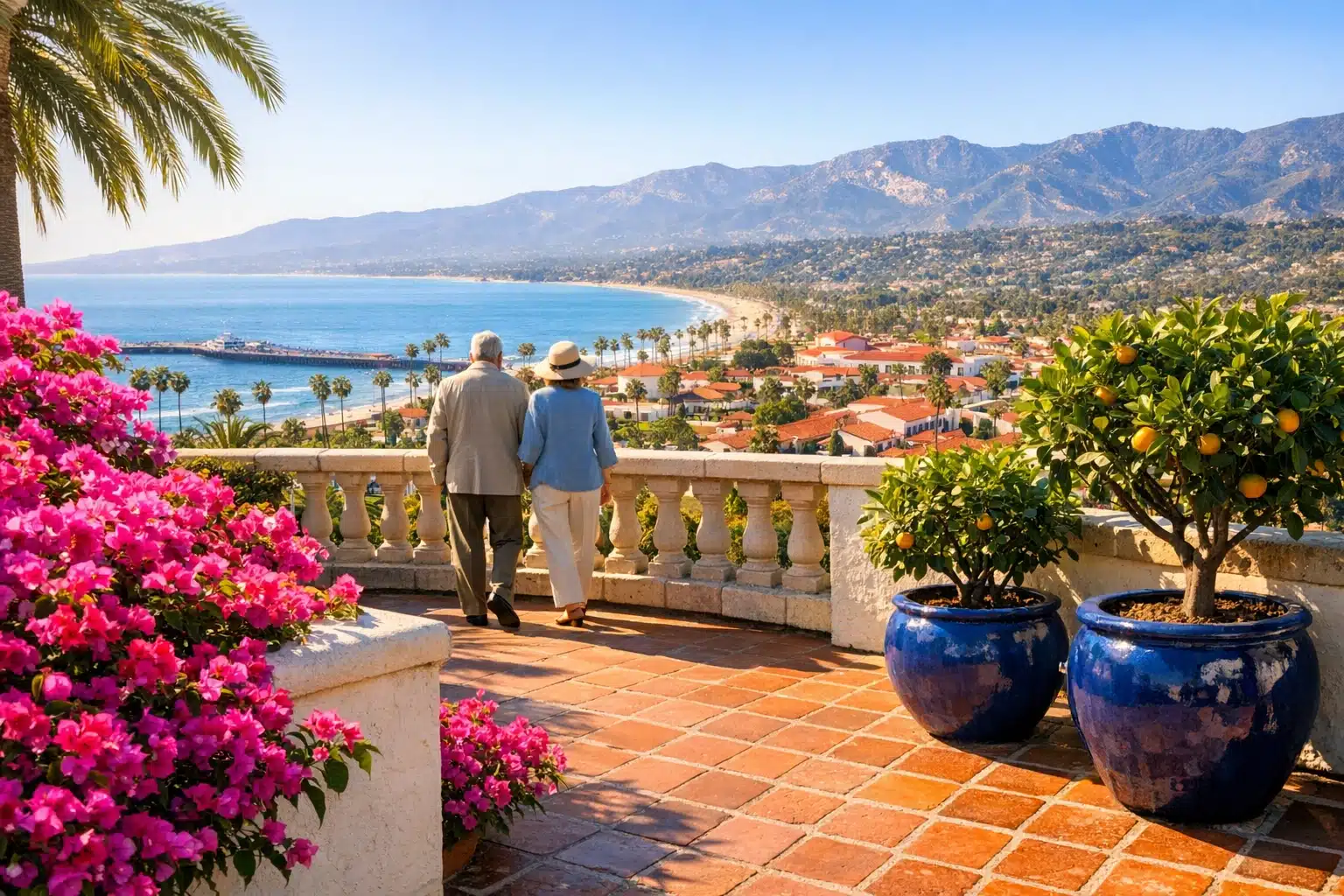
Santa Barbara is often one of the first places people picture when they imagine retirement on the California coast, and for good reason. With a population of roughly 88,000, it is large enough to feel active and well served, yet compact enough to remain manageable. The setting is undeniably attractive, with the Santa Ynez Mountains rising behind the city and the Pacific spreading out in front like a painted backdrop that never leaves the stage. For retirees, though, the appeal goes beyond scenery. Santa Barbara combines a mild climate, good healthcare access, cultural depth, and a walkable core in a way few towns can match.
One of Santa Barbara’s biggest strengths is its day-to-day ease. Downtown, the waterfront, and several residential neighborhoods offer a practical level of walkability that becomes more valuable with age. There are grocery stores, cafes, pharmacies, parks, and community spaces within short driving distances, and some areas make car-light living possible. Healthcare is another major advantage. The city is served by respected providers, including the Cottage Health system, and that matters because retirement decisions become much easier when routine appointments, urgent care, and specialists are not hours away.
Santa Barbara also stands out for retirees who want their calendar to stay full. It is one of the more culturally active towns on this list, with museums, gardens, lectures, music venues, and continuing education opportunities nearby. For some people, that creates the difference between simply living in a beautiful place and truly belonging to it. There is a rhythm here that feels lively but not frantic.
- Best for retirees who want culture, healthcare access, and polished surroundings
- Especially appealing to walkers, food lovers, and lifelong learners
- Less ideal for buyers seeking a low-cost coastal option
The trade-off is cost. Santa Barbara is among the most expensive retirement choices on the California coast, with home prices and everyday expenses that often sit well above national averages. Compared with Ventura or Pismo Beach, housing can feel steep, and that may narrow options for retirees on fixed incomes. Still, for those who can comfortably afford it, Santa Barbara delivers a rare mix of beauty and practicality. It does not merely look good in brochures; it functions well in real life. If your ideal retirement includes ocean air, medical confidence, and a city that still gives you reasons to get dressed and head out the door, Santa Barbara deserves serious attention.
Ventura: A More Relaxed and Often More Attainable Version of Coastal California
Ventura is a town that tends to win people over slowly, which may actually be its greatest strength. It does not carry the same polished reputation as Santa Barbara, nor does it market itself with the same prestige as some Orange County beach communities. Instead, Ventura offers something many retirees find even more valuable: a comfortable coastal lifestyle that feels grounded, usable, and comparatively attainable. With a population of around 110,000, Ventura is large enough to support hospitals, shopping, restaurants, and local services, yet it still keeps a friendly, approachable identity.
For retirement living, Ventura shines because it balances practicality and charm. Downtown Ventura has a genuine main-street feel, with bookstores, casual dining, cafes, galleries, and access to the beach within a compact area. The city also has a historic core that adds character without feeling overly staged. Compared with Santa Barbara, Ventura usually feels less formal and less expensive, which can be a relief for retirees who want the coast without the social pressure or housing sticker shock that often comes with prestige markets.
Healthcare access is another point in Ventura’s favor. Community Memorial Hospital and nearby regional options help give retirees confidence that they can manage routine care and more serious needs without constantly traveling long distances. The climate is also remarkably workable. Ventura has mild temperatures through much of the year, and the sea breeze often keeps summers more comfortable than inland communities. For retirees sensitive to heat, that can be a meaningful quality-of-life advantage.
Ventura’s retirement personality is subtly different from Santa Barbara’s. Where Santa Barbara can feel curated, Ventura feels lived in. Where Monterey can lean tourist-centered in some areas, Ventura tends to feel more local. That local texture matters because retirement is not a weeklong vacation. It is errands, exercise, doctors’ visits, lunch with friends, volunteer work, and finding places that still feel inviting on an ordinary Tuesday.
- Best for retirees who want a real town rather than a resort atmosphere
- Often more budget-friendly than Santa Barbara and many southern beach cities
- Strong choice for people who value a casual lifestyle and usable downtown areas
Ventura is not the cheapest place on this list, and coastal California will rarely be called inexpensive with a straight face. Still, it can offer better value than flashier neighbors while preserving the essentials that make coastal retirement attractive. For retirees who want ocean proximity, decent infrastructure, and a pace that says exhale rather than perform, Ventura is one of the smartest picks on the map.
Pismo Beach: Small-Town Scale, Ocean Calm, and a Slower Retirement Rhythm
Pismo Beach is a very different retirement prospect from Santa Barbara or Ventura, and that is exactly why it deserves a place on this list. With a population of under 9,000, it is far smaller than the other towns featured here. That smaller scale shapes everything, from traffic patterns to social dynamics to the overall emotional tone of daily life. If Santa Barbara feels refined and Ventura feels practical, Pismo Beach feels like a deep breath. It is the kind of town where the horizon seems to slow your thoughts down before you even realize it.
For retirees, Pismo Beach offers a strong case based on simplicity. The climate is mild, the ocean is always close, and the town is easy to understand. That may sound minor, but many older adults actively want less complexity rather than more stimulation. Pismo Beach can provide that. Its compact size makes errands and familiar routines more manageable, and the area’s visual calm has real psychological appeal. Morning walks near the shore, easy access to scenic overlooks, and a quieter street scene all contribute to a lower-pressure lifestyle.
There are practical considerations, of course. A smaller town means fewer big-city services within immediate reach. Healthcare options in Pismo Beach itself are more limited than in larger coastal centers, though nearby San Luis Obispo expands the picture considerably with hospitals, specialists, shopping, and cultural amenities within a reasonable drive. That relationship is part of Pismo Beach’s appeal: it offers a quieter home base while still giving residents access to a larger service hub when needed.
Pismo Beach also compares well for retirees who want a less crowded social environment. Some coastal retirement towns can feel busy, image-conscious, or seasonally overwhelmed by tourism. Pismo does have visitors, but its day-to-day personality often remains gentler than larger beach destinations. Housing is not cheap, and inventory can be limited because the town is small and desirable, but the overall lifestyle can feel less financially performative than places where luxury dominates the local identity.
- Best for retirees who prefer peace, scenery, and a smaller community footprint
- Works well for those comfortable relying on nearby San Luis Obispo for expanded services
- Less suited to people who want dense cultural programming or a large urban medical network close at hand
Pismo Beach is not trying to impress you with scale. It wins by being calm, scenic, and manageable. For retirees who want to trade noise for ocean mist and choose a place where the days can unfold at an unhurried pace, it is one of California’s most quietly compelling options.
Monterey: Scenic Depth, Intellectual Energy, and Strong Access to Essentials
Monterey offers a retirement experience that feels layered. It is visually striking, of course, with rocky shoreline, cypress-lined views, and a long relationship with the sea that gives the town real identity. But Monterey is not just scenic. It has educational energy, regional healthcare, civic amenities, and a cultural atmosphere that can be very appealing to retirees who want more than beautiful weather and a beach path. With a population of around 30,000, it strikes a middle ground between intimacy and infrastructure.
One of Monterey’s biggest strengths is the wider peninsula context. Retirees are not choosing an isolated town; they are plugging into a network that includes Pacific Grove, Carmel-by-the-Sea, Seaside, and nearby service centers. That cluster creates access to restaurants, arts, shopping, recreation, and healthcare beyond what Monterey’s population alone might suggest. Community Hospital of the Monterey Peninsula is a notable asset in the region, and for older adults, that kind of nearby medical support can weigh as heavily as scenery when making a move.
Monterey is particularly attractive for retirees who like an intellectually curious environment. The area has marine science institutions, history, lecture programs, and a visitor economy that supports museums, galleries, and public events. It can feel more reflective than flashy. Compared with Carlsbad, Monterey is cooler in climate and less suburban in layout. Compared with Pismo Beach, it offers deeper cultural infrastructure and more regional complexity. Compared with Santa Barbara, it may feel less polished but more textured, with a coastal atmosphere shaped by history and ecology rather than glamour.
The cost of living remains a significant consideration. Monterey is not a bargain destination, and desirable homes near the water or in especially attractive neighborhoods can command premium prices. Still, some retirees find that the value equation makes sense because the town supports many dimensions of later life at once: healthcare, walking, learning, scenic recreation, and access to neighboring communities.
- Best for retirees who want natural beauty paired with culture and regional services
- Strong fit for readers, walkers, volunteers, and lifelong learners
- Worth considering for those who prefer a cooler coastal climate over warmer southern beach weather
Monterey does not have the sun-soaked mood of Southern California, but that is part of its charm. It feels thoughtful, sea-shaped, and enduring. For retirees who want their surroundings to stimulate the mind as much as they soothe the eye, Monterey stands out as one of the most complete options on the California coast.
Carlsbad: Amenity-Rich, Well Connected, and Ideal for Active Retirement Years
Carlsbad is one of the strongest retirement candidates in Southern California because it blends coastal appeal with infrastructure that supports an active daily life. With a population of roughly 115,000, it is larger than several towns on this list, and that scale works in its favor. Retirees often benefit from places that have enough population to sustain good healthcare, varied housing, organized recreation, retail convenience, and transportation links. Carlsbad delivers on those basics while still keeping beaches, lagoons, and ocean views in the picture.
The city’s location in North County San Diego is a major asset. Retirees living in Carlsbad can access not only local services but also the broader resources of the San Diego region, including hospitals, specialists, airports, cultural venues, and major transportation routes. That regional connectivity sets Carlsbad apart from smaller coastal towns that feel idyllic but require more planning for medical appointments, travel, or specialized services. For older adults who want a place that can adapt with them over time, that flexibility matters.
Carlsbad also stands out for lifestyle variety. Some retirees want days built around beach walks and quiet mornings, while others want golf, community programs, fitness classes, restaurants, and frequent visits from family. Carlsbad can support both. The village area has charm and walkable pockets, while the broader city offers shopping centers, planned neighborhoods, and recreational facilities that make everyday life efficient. Compared with Monterey, Carlsbad is warmer and more suburban. Compared with Santa Barbara, it can feel less romantic but often more functionally spread out and regionally connected. Compared with Ventura, it generally comes with a higher price tag but also a broader amenity base.
That price tag is the main caution. Carlsbad is expensive, and desirable neighborhoods near the coast can be especially costly. However, for retirees who have the budget, the town offers a strong mix of quality-of-life features that can justify the premium. The weather is one of the biggest draws, with mild winters and many comfortable outdoor days across the year.
- Best for active retirees who want coastal living with major regional support
- Excellent choice for those who value healthcare options, travel convenience, and recreation
- Less appealing for buyers seeking a quiet, small-town atmosphere or lower housing costs
Carlsbad feels less like a hideaway and more like a well-equipped launch point for retirement. You can spend the morning by the water, meet friends for lunch, get to appointments without heroic effort, and still have access to a large metro area when needed. For retirees who want the coast without sacrificing convenience, Carlsbad is one of the most practical upscale choices in the state.
Conclusion: Choosing the Right California Coast for Your Retirement Style
The best coastal town for retirement is rarely the one with the most famous view; it is the one that fits the life you actually plan to live. Santa Barbara works beautifully for retirees who want culture, strong healthcare, and a polished environment, though the cost can be substantial. Ventura offers a more relaxed and often more affordable balance, making it a smart choice for people who want everyday usability over prestige. Pismo Beach suits those who value quiet routines and small-town calm, especially if they are comfortable leaning on nearby San Luis Obispo for broader services. Monterey is ideal for retirees who want natural beauty, regional healthcare, and a setting with intellectual and cultural depth. Carlsbad stands out for active older adults who want warmth, amenities, and easy connection to a major metro area.
If you are comparing these towns for your own next move, focus on five questions before falling in love with the scenery: Can I comfortably afford housing and daily costs here? How easy will healthcare become five or ten years from now? Will I enjoy the pace in every season, not just on a sunny weekend? Can I build a routine with friends, hobbies, and errands that feels sustainable? And does this town support the version of retirement I actually want, not just the one that looks good in a travel photo? Answer those honestly, and your best coastal town becomes much easier to recognize.