3-Night Cruises From Newcastle: What to Expect and How to Choose
Choosing a 3-night cruise from Newcastle is less about chasing distance and more about making a short escape count. In a few days, you can swap roads and inboxes for open decks, late dinners, and a changing horizon without needing a long holiday allowance. Because these sailings are brief, every detail matters more, from departure port logistics to cabin choice and onboard style. A little planning turns a quick trip into a well-judged break rather than an expensive rush.
- What 3-night cruises from Newcastle usually involve and why they appeal to short-break travelers
- How itineraries, sea days, and port time shape the overall experience
- What to compare when choosing a ship, cabin, and cruise style
- How to budget for fares, extras, and travel to the port without surprises
- Which travelers are most likely to enjoy this format and when it may not be the right fit
Understanding the Appeal of a 3-Night Cruise From Newcastle
For travelers in North East England, one of the biggest advantages of booking a short cruise from Newcastle is simple convenience. Instead of heading to a major southern port or dealing with airport security before the holiday has even begun, many passengers can reach the departure point by car, train, or taxi in a manageable amount of time. In practice, cruises marketed as leaving from Newcastle usually sail from the Port of Tyne, near North Shields, rather than the city centre itself. That detail matters, because a local departure can cut costs, reduce stress, and make the trip feel achievable even for people with limited time off.
A 3-night sailing also works well as a trial run. Plenty of travelers are curious about cruising but hesitate to book a week-long voyage without knowing whether they will enjoy the rhythm of ship life. A shorter itinerary offers a useful test. You get to experience embarkation, dining rotations, live entertainment, cabin comfort, and time at sea without making a large financial or time commitment. If you love it, you can book something longer next time with more confidence. If you decide cruising is not your style, you have learned that lesson over a long weekend rather than over ten days.
Another reason these departures remain appealing is that they fit modern schedules. Not everyone can step away for a full summer holiday, yet many people still want a break that feels more distinctive than a hotel stay down the road. A short cruise can deliver that change of scene quickly. Even a cold breeze on deck has its own charm when the shoreline begins to slip away and the ordinary week is left behind.
That said, not all 3-night cruises are identical. Some are best understood as sampler cruises focused on the ship itself. Others may include one nearby stop, a themed onboard program, or a schedule that resembles a mini-break at sea more than a destination-heavy journey. Geography plays a role here. From the North East coast, long-distance port hopping is unrealistic in such a short window, so the value of the trip often comes from atmosphere, service, food, and ease rather than from ticking off multiple cities.
- Best for: first-time cruisers, couples, friends, and busy professionals
- Main draw: local departure and low time commitment
- Main trade-off: limited destination time compared with longer sailings
Seen in that light, a 3-night cruise from Newcastle is not a small version of a grand voyage. It is its own travel format, with its own strengths, pace, and decision points.
What to Expect From the Itinerary and Onboard Experience
The biggest mistake first-time bookers make is assuming that a 3-night cruise will deliver the same balance of ports and sea days as a week-long itinerary. In reality, short departures from Newcastle usually emphasize the shipboard experience. Distances in the North Sea mean cruise lines have limited room to include several substantial stops without turning the trip into a race against the clock. As a result, many sailings are structured around one of three patterns: a mostly at-sea sampler, a themed mini-cruise, or a short route with a single practical stop.
A typical schedule often starts with afternoon embarkation on day one. Passengers check in, find their cabin, complete the safety drill, and spend the first evening exploring lounges, restaurants, the theatre, and open decks. Day two is frequently the most relaxed part of the trip. This is when the ship becomes the destination. You might linger over breakfast, attend a talk or cooking demo, book a spa treatment, watch the sea change colour under a fast-moving sky, or simply claim a seat by a window with a coffee. Day three may include a port call, scenic sailing, or additional onboard programming before the final night onboard. Day four is devoted to breakfast, disembarkation, and the trip home.
Because time is short, expectations matter. On a 3-night cruise, you are not likely to spend long hours discovering multiple museums, beaches, and old towns ashore. What you are more likely to get is a concentrated taste of cruise culture: several meals included in the fare, evening entertainment, bars and lounges, quizzes, live music, and a cabin that acts as your private retreat between activities. Some lines lean into a quiet, adult atmosphere with talks, music, and classic dining. Others create a livelier mood with broader entertainment and a busier social scene.
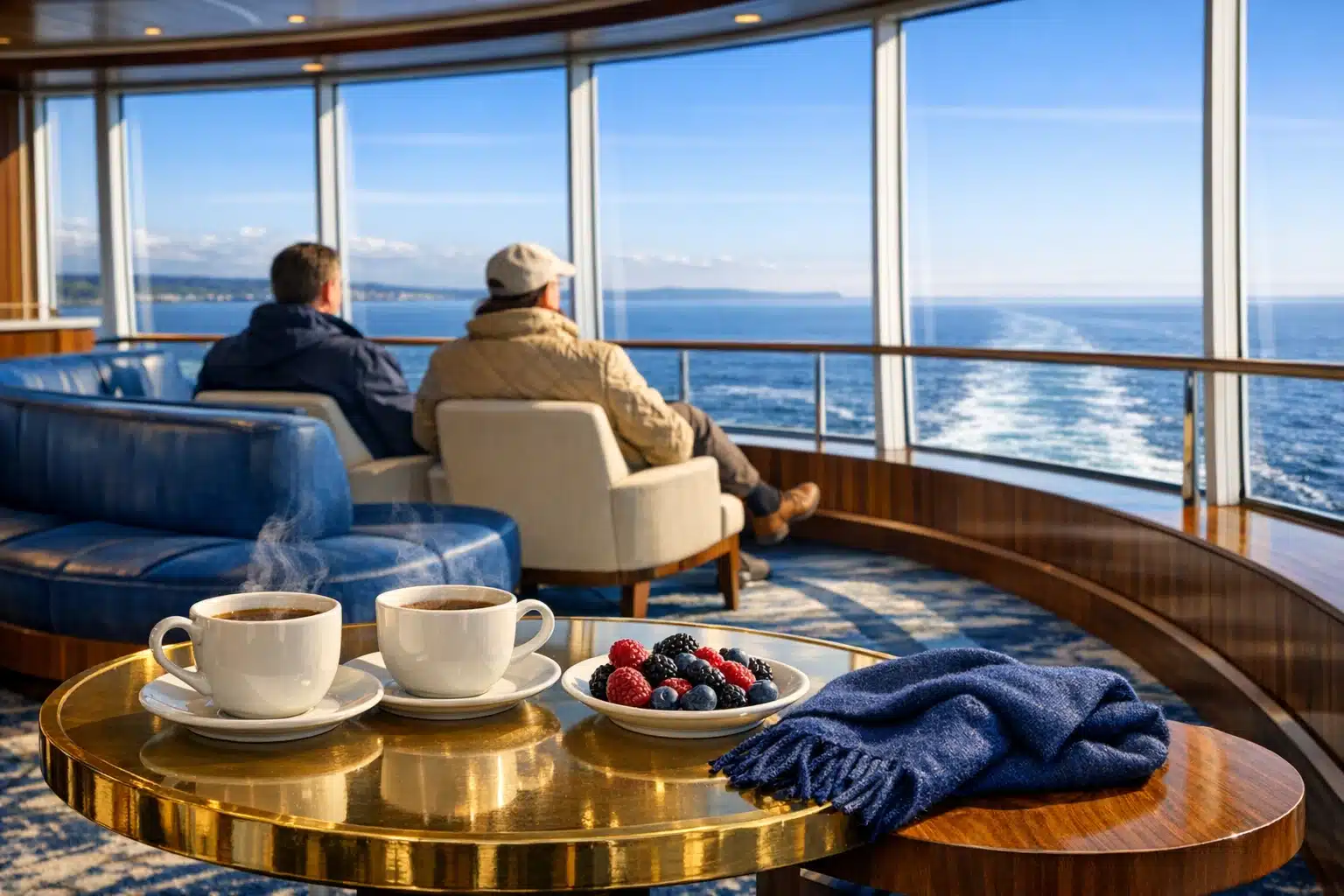
Weather can also shape the experience more than many newcomers expect. Departures from Newcastle often involve North Sea conditions, and that means cool air, wind, and occasional motion even outside winter. A balcony can still be lovely, but many passengers spend more time in enclosed observation lounges than on sun decks. That is not a flaw; it simply changes the mood. Think less tropical postcard, more cinematic seascape.
- Expect the ship itself to be a major part of the holiday
- Do not assume several long port visits in only three nights
- Pack layers, as outdoor conditions can change quickly
- Check whether the sailing is destination-led or themed around onboard entertainment
If you board with the right mindset, the compact nature of the trip becomes an advantage. Nothing feels wasted, and the days take on a neat, contained shape that suits a short break remarkably well.
How to Choose the Right Cruise, Ship, and Cabin
Choosing well matters more on a short cruise than many people realize, because there is less time to recover from a poor match. On a longer sailing, an average cabin or an uninspiring dining venue can be balanced by excellent ports later in the trip. On a 3-night cruise, the ship is carrying much more of the experience, so the right fit depends on style as much as price.
Start with the cruise line and the type of ship. Newcastle departures often attract travelers looking for convenience, and the market can include smaller traditional ships, adult-focused sailings, and short-break itineraries designed around the social side of cruising. That means you should look beyond the headline fare and ask what sort of atmosphere you actually want. Do you picture a calm trip with lounges, conversation, and a well-paced dinner service? Or do you want a busier ship with more entertainment, more families, and more late-night energy? Neither option is automatically better; they simply suit different passengers.
Ship design matters too. On a short North Sea sailing, indoor public spaces are especially important. A vessel with comfortable observation lounges, cafés, and sheltered seating can feel far more enjoyable than one that seems built mainly around hot-weather deck life. Review the deck plan before booking. If the weather turns brisk, will there still be enough places where you would genuinely want to spend time?
Cabin choice deserves careful thought. An inside cabin is often the cheapest route onto the ship and can be excellent value for travelers who plan to spend most of their time in public areas. An ocean-view cabin adds natural light, which many people appreciate even on a short trip. A balcony sounds tempting, but its value depends on season and personal habits. If you love stepping outside with a morning coffee, it may be worth the extra cost. If you tend to use the cabin only for sleeping and showering, that money may be better spent elsewhere. For passengers concerned about motion, a midship cabin on a lower deck is usually a sensible pick.
- Compare atmosphere, not just price
- Check whether the ship has strong indoor spaces for cooler weather
- Choose a cabin based on how you actually travel, not on fantasy usage
- Review dining times, dress expectations, and included venues before booking
It is also wise to examine what is included. Some fares cover more dining options than others. Some ships make specialty restaurants, drinks packages, or Wi-Fi upgrades highly visible during the booking process, and these extras can blur the true value of the cruise. On a 3-night itinerary, simple often wins. A well-priced cabin on a ship whose atmosphere suits you will usually beat a more expensive booking padded with upgrades you barely have time to enjoy.
Budgeting, Booking Strategy, and Practical Planning
A short cruise can look inexpensive at first glance, but total cost matters more than the lead fare. This is where many travelers misjudge value. A 3-night sailing may advertise an attractive starting price, yet the full spend can rise once you add drinks, specialty dining, parking, travel to the port, travel insurance, gratuities where applicable, and pre-cruise hotel stays if you prefer an overnight near the terminal. None of these costs are unusual, but on a short trip they make up a larger share of the total budget, so they deserve close attention.
Think in terms of cost per usable day rather than just headline price. A short cruise gives you fewer evenings and fewer meals to spread optional spending across. For example, a drinks package that looks sensible on a week-long holiday may offer weaker value over only three nights, especially if you spend one evening exploring the ship and another preparing for early disembarkation. The same logic applies to specialty dining. Booking one standout meal may be worthwhile; booking several add-ons on a compact itinerary can quickly feel excessive.
Timing can influence price as well. Sailings around bank holidays, festive periods, and school breaks often draw stronger demand. Booking early may give you better cabin selection, while late deals can sometimes reward flexible travelers who are not fixed on a particular deck or room type. There is no universal formula. The better approach is to set a realistic total budget first and then compare what each fare includes.
Practical planning is refreshingly simple if you do it in advance. Most Newcastle-area departures use the Port of Tyne, so check parking options, transfer arrangements, and boarding times carefully. If you are arriving by rail, plan the final leg to the terminal rather than assuming it is walkable from Newcastle station. A half-hour of local logistics can save an hour of stress on embarkation day.
- Important costs to review: fare, port charges, drinks, parking, transport, insurance, and onboard extras
- Useful documents: passport or required identification, booking confirmation, travel insurance details, and any health or mobility notes needed for the cruise line
- Smart packing items: layers, comfortable shoes, a waterproof outer layer, medications, charger plugs, and a small day bag
One final tip: do not overpack. A 3-night cruise is brief, and the smartest suitcase is usually the one that makes embarkation and disembarkation easier rather than the one prepared for every imaginable outfit change. Short cruises reward light, practical planning. If the basics are covered, the rest of the holiday can unfold with satisfying ease.
Final Thoughts: Who Should Book a 3-Night Cruise From Newcastle?
A 3-night cruise from Newcastle suits a very specific kind of traveler, and that is exactly why it works so well when booked for the right reasons. If you live in the North East, Yorkshire, southern Scotland, or anywhere that makes the Port of Tyne easier than a flight or a long drive south, the format is especially attractive. It offers a clean break from routine without demanding a full-scale holiday operation. You can leave home with one suitcase, settle into your cabin that afternoon, and by evening the coast is already behind you.
These short sailings are particularly good for first-time cruisers, couples wanting a compact escape, groups of friends celebrating a birthday or reunion, and professionals who find it easier to spare a Friday and a Monday than an entire week. They also suit travelers who enjoy the ritual of cruising itself: dinner service, live music, watching the sea from a warm lounge, and waking up somewhere between departure and return with that quiet sense of being briefly removed from normal life. In a world full of rushed travel, there is something surprisingly luxurious about letting the ship set the pace.
At the same time, this is not the ideal choice for everyone. If your main goal is deep destination exploration, reliable sun, or a busy schedule of shore excursions, you may find the format too limited. Likewise, travelers who dislike cool-weather sailing, are very sensitive to motion, or expect nonstop novelty may be better served by a longer itinerary from a larger departure port. The point is not to oversell the product. A 3-night cruise is a focused experience, not an all-purpose holiday.
For the right passenger, though, it can be excellent value in the broader sense of the word. Not merely cheap, but efficient, enjoyable, and proportionate to the time available. Choose the sailing with clear eyes. Prioritize atmosphere over marketing gloss, practical access over romantic assumptions, and total cost over the first price you see. If you do that, a short cruise from Newcastle can deliver exactly what many travelers need: a neat, refreshing change of scene that feels bigger than the calendar suggests.
In short, book one if you want a nearby departure, a taste of life at sea, and a break that fits into real life rather than interrupting it. That is the audience these cruises serve best, and when expectations match the format, they can feel delightfully well judged.